
Spring Repair · Simi Valley, CA
Torsion Spring Repair for Simi Valley Garage Doors
Broken torsion spring on a Simi Valley garage door? See why 1956-1999 construction and mild-climate wear make springs fail here, and what the repair takes.
What the Repair Takes
A torsion spring repair starts with the door closed and the opener unplugged, because a wound spring under tension is the most dangerous part on the whole system. We measure the broken spring's wire size, length, and inside diameter against the door's weight and cycle rating, not just swap in whatever's closest on the shelf. Mismatched spring rate is one of the most common comebacks in this trade, and it usually traces to someone guessing instead of measuring.
We check the drums, the lift cables, and the center bearing plate at the same time, since a spring rarely fails in isolation. Cables fray where they wrap the drum, bearings seize and chew into the shaft, and a worn bearing will take out a new spring in months if it's left in place. On doors where the torsion hardware is original to a 1960s-1980s build, we're often dealing with a single spring sized for a lighter wood door that's since been replaced with a heavier insulated steel one, which means a full re-rate rather than a like-for-like swap.
Winding is done with proper bars, to the manufacturer's turn count, with a safety cable through the spring if one isn't already there. We don't leave a job with a spring wound to "close enough." One limitation worth saying plainly: if a drum or shaft is bent, that's a bigger job than a spring swap, and we'll tell you before we start, not after.
How Long It Takes
A straightforward torsion spring replacement, where the drums, cables, and bearing plate are in decent shape, is a single visit. Add a worn bearing, a bent shaft, or a cable that needs replacing alongside the spring, and the visit runs longer because those parts get addressed in the same trip rather than scheduled as a return call.
Two-spring systems on heavier double doors take a bit more time than a single-spring setup on a lighter door, since both springs usually get replaced together even if only one broke - the other is close behind it on cycle life and leaving it is a short-term fix, not a real one.
We won't quote a number of minutes here because it depends on what we find once the door's open, and on whether the exact spring size is one we carry on the truck or one that needs to be sourced. That second case is the honest limitation: some less common spring sizes, especially on older or custom doors, aren't something every supplier stocks, and that can turn a same-day repair into a short wait. We'd rather tell you that up front than promise a timeline we can't back up.
Why This Fails Locally
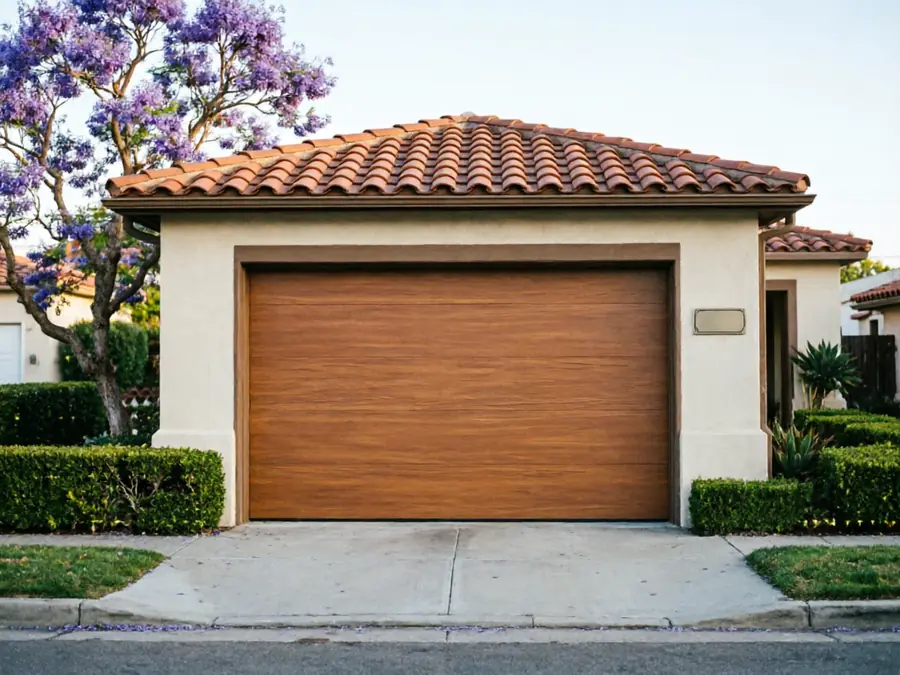
Housing across this service area was mostly built between 1956 and 1999, with a median year of 1983, and the bulk of the stock in the 17 named communities we cover dates to the 1980s and 90s. That matters for springs because torsion springs are rated in cycles, not years, and a door that's opened and closed a few times a day for four decades is going to hit the end of that rating regardless of how well it was built originally.
The climate here is mild temperate, without the hard freeze-thaw swings that crack spring coatings in colder regions or the constant salt-air corrosion you'd get near the coast. That's actually part of why spring failure here looks different: it's rarely a rust-out. It's fatigue from straight cycle count, on hardware that in a lot of these 1980s and 90s builds has never been touched since the house was framed.
With 37,120 owner-occupied houses across roughly 69,002 households in this area, a large share of garages are sitting right at that point where a spring installed when the house was new is simply done. It's not a sign anything was installed wrong. It's a sign the door's been doing its job for thirty or forty years.
The Symptom
The clearest sign is a loud bang from the garage, usually when no one's near the door - that's the spring letting go, not the door itself failing. After that, the door won't open with the opener, or the opener strains and hums without lifting it. Lift the door by hand with the opener disconnected and it'll feel heavy, uneven, or like it wants to slam back down, because the spring isn't doing its job of counterbalancing the weight anymore.
Some owners notice it earlier: a visible gap in the coils of the spring above the door, a cable that's gone slack on one side, or the door tilting slightly as it opens because one spring on a double system is weaker than the other. None of those are things to wait out. A door running on one working spring, or no working spring, puts the full weight on the opener and the remaining hardware, and that's how a spring problem turns into a drum, cable, or opener gear problem.
If you're not sure what you're looking at, it's worth a look before you try to force the door open or closed by hand.
Service areas
Where we work around Simi Valley
Simi Valley and 7 nearby communities, each with its own page.
FAQ
Questions about this
How do I know it's the spring and not the opener?
Disconnect the opener using the release cord and try lifting the door by hand. If it's heavy, uneven, or won't stay up on its own, the spring isn't counterbalancing it anymore - that's a spring problem, not an opener problem, even though the opener is what seemed to quit first.
Do you replace one spring or both on a double door?
If it's a two-spring system, we typically replace both, even if only one broke. They're matched to the same cycle count and installed at the same time, so the second one is usually close behind. Replacing just one is cheaper short-term but often means a second visit soon after.
Can I just tighten or re-stretch the old spring instead of replacing it?
No. A torsion spring that's broken or badly fatigued can't be reset - the steel has lost its temper. Attempting to re-wind a compromised spring is also one of the more dangerous DIY mistakes on a garage door, since it's under full tension.
Why did my spring break if the house isn't that old?
Springs are rated in cycles, not years. A door used several times a day will hit the end of a spring's rated life well before the house itself shows any age, especially on original hardware that's never been upgraded or re-rated for a heavier replacement door.
Tell us what your door is doing.
We serve Simi Valley, CA and nearby communities. Every job starts with a diagnosis, so you know what failed before any work begins.