
Garage Door Repair · Castaic
Garage Door Repair for Castaic's 1990-Era Doors
Most Castaic garage doors date to around 1990. We know what that means for springs, openers, and sensors, and we drive the 16 miles from Simi Valley to fix it.
How Long It Takes
Castaic's housing stock centers on 1990, almost a decade newer than the 1956-1999 range and 1983 median that covers the wider service area we work. That gap matters more than it sounds. A torsion spring is rated for somewhere between 7,000 and 12,000 cycles, which on an average household works out to 7-12 years. If your door is original to a 1990 build, the spring has already failed and been swapped at least once, maybe twice, usually by whoever owned the house before you. What's often still original is the opener itself - a chain-drive unit from before the federal photo-eye sensor requirement took effect in 1993. That's the part we check first, because a pre-1993 opener with no working sensors isn't a repair job, it's a liability. We're coming from Simi Valley, 16 miles out, so we build that drive into the schedule rather than promise a window we can't hold from here. We don't quote arrival times sight unseen.
Parts We Carry
For a door from the early 90s we're usually dealing with steel panel sections on roller tracks, standard torsion spring setups, and galvanized rollers rather than the nylon rollers that came later. We carry replacement torsion springs sized for that era's door weights, standard track hardware, and photo-eye sensor kits for the openers that predate them - that last one is the most common single fix on a Castaic call, more than the spring itself some weeks. Castaic sits in the same mild temperate band as the rest of the area, so we're not fighting the rust and ice-crack failures you'd see somewhere with real winters; what wears out here is cycle fatigue and sun-dried weatherstripping, not corrosion. One limitation worth saying plainly: if your door uses a discontinued panel profile from a builder that's long gone, we can source a close match, but an exact replacement panel can take a special order. We'll tell you that on the spot rather than let you wait on a part that isn't coming.
Booking a Visit
Because Castaic is the 16-mile end of our run from Simi Valley, we try to confirm a time window before we load the truck rather than work it out at the curb. Tell us the make of opener if you know it and whether the door still has working sensors at the base of the track - that one detail changes what we bring. With roughly 5,816 households in Castaic, most on a similar build-year door, we see the same two or three failures on repeat: dead sensors, a spring that let go without warning, or a cable that frayed through on an old drum. If yours is something else entirely, say so when you call and we'll bring more than one set of parts. See our Castaic page for the rest of what we handle out here, or the Simi Valley page for where we're based.
What the Repair Takes
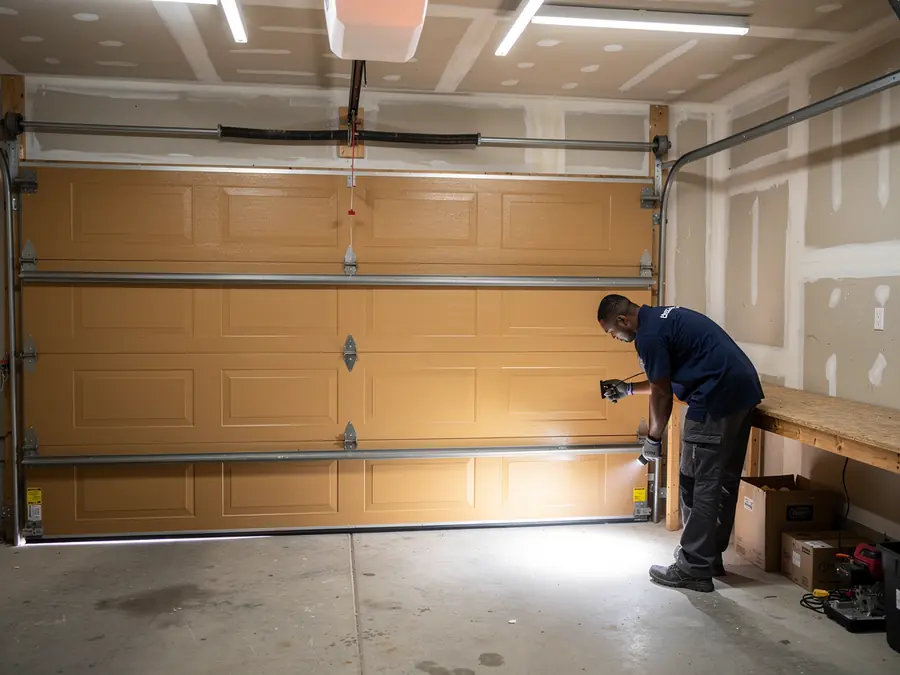
We start at the opener, not the spring, because on a house this age the sensor question decides everything else. If the photo-eyes are missing or dead, that gets fixed or replaced before anything else, full stop - a door that reverses on command but not on an obstruction isn't done. From there we check the spring for stretch and rust on the coil, the cables for fraying at the drum, and the rollers for the flat spots that show up after thirty years of the same stretch of track. On a straightforward torsion spring swap we're in and out inside the hour once we're on site. A full opener replacement with new sensors and wiring takes longer, closer to two hours, because we're also making sure the new unit's travel limits match a door frame that's three decades old and has settled a little, the way frames do.
The Cost of This Job
We don't post a flat price here because what you need depends on whether this is a sensor fix, a spring swap, or a full opener replacement, and those are different jobs with different parts. What we can say is that Castaic's median household income of $132,153 tends to push people toward fixing it right the first time rather than patching around a bad sensor repeatedly - we see fewer repeat calls out here than on an under-maintained door. If your opener is original to 1990 and the sensors are already failing, replacement usually beats repair on cost per year, not just convenience; we'll say so even when a patch would get you through the week, because a patch on a thirty-year-old chain drive doesn't buy you much time.
FAQ
Questions about this
Is my garage door opener too old to just fix the sensors?
Usually not. If the opener still runs and the motor's sound, swapping in a photo-eye sensor kit is a straightforward fix, not a reason to replace the whole unit. We only recommend full replacement when the motor itself is failing alongside the sensors, which does happen on units this age.
How far out is Castaic from your shop?
About 16 miles from our base in Simi Valley. We factor that drive into scheduling rather than promise a tight arrival window, so confirming a time slot ahead of the visit works better than a same-day call for non-emergencies.
Why does my spring keep failing faster than my neighbor's?
Cycle count, not age alone. A door used several times a day wears through its rated cycles faster than one used once. On houses built around 1990, we often find the spring's already been replaced once by a prior owner, so you may be on your second or third.
Do you carry parts for older panel styles?
For standard steel panel and track hardware from the early 90s, yes. A specific discontinued panel profile from a builder no longer in business sometimes needs a special order - we'll tell you upfront if that's the case rather than guess.
Tell us what your door is doing.
We serve Simi Valley, CA and nearby communities. Every job starts with a diagnosis, so you know what failed before any work begins.